


£
300,000
Annual gas usage reduction
3,000
tonnes
Annual CO₂ saved
5
%
Emission reduction target achieved
Steam System Energy Efficiency
This University Hospital Trust (“the Trust”), had a responsibility to become more sustainable and reduce the city’s carbon footprint by operating more efficiently. At the same time, in line with the Government’s carbon reduction target of 80% by 2050, the Trust set a corporate objective to reduce carbon emissions by 5% per annum. Faced with the challenge of identifying new energy saving projects and the ever-rising gas price, the Trust’s Energy & Sustainability Manager decided to look at their extensive steam system to find savings.
Thermal Energy International, the leading energy efficiency solutions provider, proposed a project to regain 80% of the boiler plants’ wasted energy. Across the two phases of the project, the Trust has made reductions in gas usage by more than £300,000 a year. Together, these phases have saved over 3,000 tonnes of CO₂, which has helped the Trust overachieve the 5% target of emission reduction set.
Putting waste heat to good use
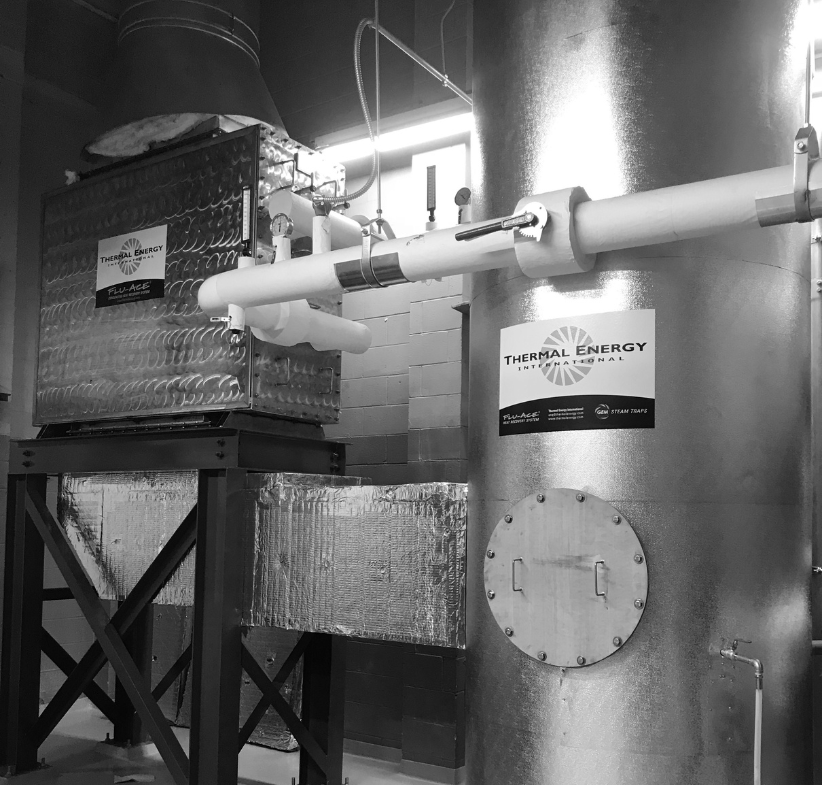
Phase one saw Thermal Energy install its proprietary FLU-ACE technology at the site. The heat recovery unit makes use of the waste heat from the Trust’s three 6.4 MW boilers and the exhaust gasses from the 8 MW CHP plant downstream of waste heat steam generator.
The recovered energy is used to pre-heat the boiler house makeup water and displace steam from the Domestic Hot Water (DHW) and heating systems in the Maternity ward 600m away. By putting this waste energy to use, the Trust is saving 11 million kWh of gas and 2,070 tonnes of CO₂ per annum.
The installation of the unit was achieved without shutting down the boiler house and only required between three to four hours downtime for each individual boiler, maintaining sufficient steam generation capacity to provide services for patients and wards throughout the install.
The Energy and Sustainability Manager said:
We have an excellent ongoing partnership with Thermal Energy International. Any issues are sorted quickly and with no disruption to patient services.
The FLU-ACE is designed to be low maintenance. The control panel continually records the heat being recovered by the hospital and provides fault warnings if there are any issues. Based on this, Thermal Energy can also make minor adjustments to optimise heat recovery remotely and will be on site for any problems.
Optimising steam trap efficiency
The second phase of the project addressed the site’s inefficient steam trapping. This involved converting all 337 mechanical steam traps to Thermal Energy’s efficient GEM™ Trap. Due to their design, mechanical traps frequently fail in the hot, dirty, pressurised environment of a steam system; either in an open position wasting large amounts of energy or closed preventing heat transfer and causing potentially dangerous water hammer.
Unlike mechanical steam traps, which discharge condensate by opening and closing, the GEM™ Trap has no moving parts. GEM™ Traps use an orifice and multi-staged throat design to manage variable condensate flow rates. With no parts to break or wear, GEM™ Traps cannot fail open, eliminating live steam loss to save sites energy and money as well as reduce a facility’s carbon footprint. To ensure there is no wastage of live steam, Thermal Energy’s engineers design each GEM™ Trap for its specific application.
Since conventional mechanical steam traps fail at an industry accepted rate of 10% per year, steam trap maintenance can be time consuming with simple audits often taking up to a week. However, the low maintenance GEM™ steam traps require only occasional filter and orifice cleaning. This can be completed inline in less than five minutes with Thermal Energy’s GEM™ servicing tool, and saves sites significant maintenance time and money as surveying and replacing failed traps is no longer required. Each GEM™ Trap is performance guaranteed for 10 years with most remaining in operation well beyond this.
Funding the future
In order to deliver the project, an operating lease agreement was built so that the Trust could immediately benefit from the carbon savings and increased efficiency, while using some of the financial savings to pay for it.
This allowed the project to provide the benefits, without the drawbacks of owning capital equipment and compromising budgets reserved for patient care.
In any organisation, protecting an investment is integral to it achieving its return. For that reason, the Trust took out a seven-year servicing contract with Thermal Energy covering both FLU-ACE and GEM.
Explore More Case Studies
Speak to our team
If you are reviewing energy performance across hospital or healthcare estates, our engineers can assess your steam and boiler systems, identify avoidable losses and build a clear, validated plan to reduce fuel use, operating costs and carbon emissions.