


~
1,733,600
m³
Natural gas reduction
>
3,300
tonnes
CO₂ savings
<
2
Payback (Years)
This customer sought to cut reliance on natural gas, lower carbon emissions and secure reliable energy performance by improving the efficiency of its long-established Combined Heat and Power (CHP) system.
Operating as a co-operative with a long-term view on investment, the business had already invested in a 5MWe CHP plant many years ago to provide essential heat and power across a large, complex site with multiple production processes. However, significant recoverable energy was still being lost through the exhaust, creating unnecessary fuel use and emissions while presenting a clear opportunity for improved efficiency and sustainability.
By implementing a fully integrated heat recovery system, Thermal Energy International enabled the dairy customer to achieve substantial efficiency gains while safeguarding product quality, process reliability and uninterrupted operations.
Challenge
Maximising recovery from the CHP system required integration within a tightly controlled operating environment. The steam network was interdependent and served through a common hot water loop, where flow temperatures had to remain stable across all demand points. Dampers and sensors set hard operating limits that accurately managed the process controls, with precision. Strict hygiene and reliability standards allowed no margin for error, and the solution had to be delivered without any impact on product quality or continuity of supply.
Recovering High-grade Heat Across Critical Processes
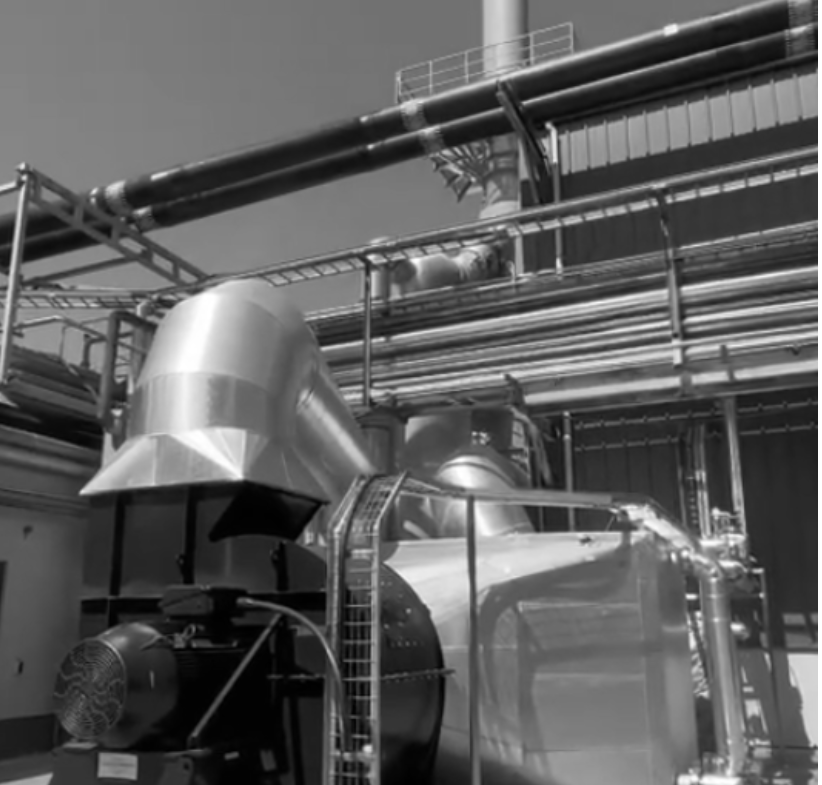
Thermal Energy International delivered a fully integrated heat recovery system designed to maximise efficiency while operating within the site’s strict technical parameters. The project included replacement of the CHP chimney and installation of a FLU-ACE direct contact heat recovery unit with a supporting fin tube economiser, engineered to capture waste heat from the exhaust of the waste heat boiler after the existing economiser. This recovered energy was redirected into the site’s existing hot water network, preheating flows to 96°C, offsetting steam loads across the site and improving overall CHP efficiency by more than 10%.
Recovered heat was applied directly into two critical streams:
- Pasteurisation water: Preheating was delivered upstream of the steam heat exchangers to reduce steam demand, with strict temperature control maintained to protect product quality.
- Boiler feed water: The feed stream temperature was significantly increased by removing parasitic loads, improving overall boiler efficiency and further reducing steam demand.
Delivered as a turnkey package, the project combined mechanical, process and commissioning expertise to provide a seamless and reliable solution.
Assured Performance and Process Security
Configured to operate as a side stream to the existing heating systems, the FLU-ACE installation ensured that in the event of shutdowns or servicing, manufacturing processes continued without manual intervention or disruption. Advanced controls were applied to manage damper positions, sensor thresholds and return temperatures, maintaining system stability while maximising recovery. This safeguarded both process reliability and product quality while enabling the site to capture the full benefit of waste heat recovery.
Demonstrated Efficiency and Emissions Reduction
The FLU-ACE system is already delivering up to 3.2 MW of recovered energy, averaging more than 2.4 MW across the year. This represents an improvement in CHP efficiency of more than 15% and annual energy savings in excess of 18,000 MWh. Natural gas use has been cut by around 1,733,600 m³, avoiding over 3,300 tonnes of CO₂ emissions each year together with significant reductions in particulate matter and acid gases.
The project achieved a payback of less than two years while maintaining full production reliability and product quality.
Expansion Capacity
By building on the hot water network already in place, the installation provides not only immediate efficiency gains but also capacity for expansion. Additional heat sinks, dryer intake air and potential integration with heat pump projects are expected to unlock a further 700 kW of recovery and more than 1,000 tonnes of additional CO₂ savings in the years ahead.
Explore More Dairy Case Studies
Thermal Energy International understands the operational demands of dairy processing, from stringent quality standards to energy-intensive production and highly competitive global markets. Our proven technologies improve thermal efficiency while maintaining process integrity. By combining robust engineering with practical deployment, we enable dairy producers to lower operating costs, reduce emissions, and safeguard product quality.
Speak to our team
Complete the form to speak with a thermal energy specialist about proven solutions that deliver measurable savings with minimal operational risk.