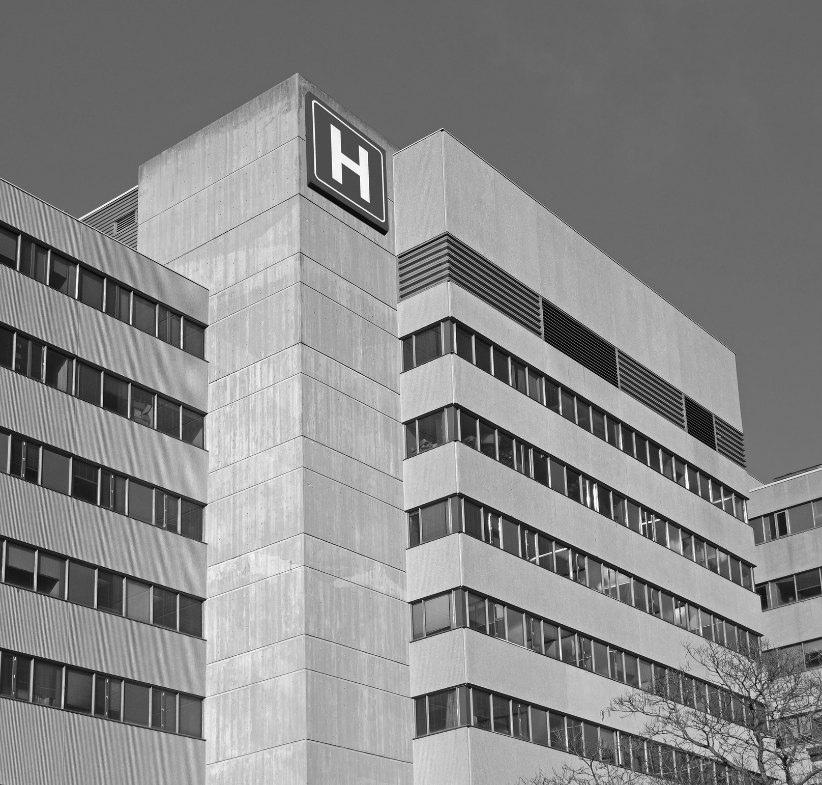
Major University Hospital
Operating continuously for 35 years within a legacy high-pressure steam plant, the systems recover boiler flue gas energy to support critical 24/7 heating loads in a Canadian winter climate.
Hospitals
Canada
PERCO-ACE™ & FLU-ACE™

The project represented the first application of a direct-contact water heater as the primary heat source for a building space-heating system.
As one of the oldest hospitals in its province, the facility represents a complex legacy infrastructure shaped by nearly a century of continuous operation. Originally constructed in the early twentieth century as a single-purpose building, it expanded incrementally over time through successive additions rather than as a unified campus, resulting in interconnected buildings constructed to different standards and in different eras.
Within this complex legacy infrastructure, the FLU-ACE boiler exhaust energy recovery unit used for domestic and laundry hot water preheating, perimeter heating, and the PERCO-ACE water heater serving the space heating duty of the laundry facility remains fully operational after 35 years of continuous service. Over that period the systems have saved substantial quantities of heat that would otherwise have been discharged through the stacks while maintaining dependable hot water production for critical hospital operations.
All monetary values are shown in Canadian dollars (CAD), reflecting the project’s location and the period in which the results were achieved.
The heating plant supplies steam to multiple buildings for space and ventilation air heating, domestic hot water generation, and process loads such as laundry, catering, and sterilisation, with varying demand profiles.
Constructed in 1925 as a standalone building, the boiler room was originally designed around coal-fired steam generation, with three high-pressure boilers serving both heating and process loads. Steam-actuated auxiliaries, including hot water circulation and boiler make-up systems, reflected a design philosophy centred on continuous steam availability rather than variable demand.
As the estate expanded, the boiler room was adapted rather than redesigned. Additional boilers were installed to serve new buildings, and the original units were successively converted from coal to heavy oil and later to natural gas. While these modifications extended the service life of the plant, the fundamental system configuration remained rooted in its original coal-based design.
The boilers operated with low efficiency, particularly at part load, and offered little operational flexibility as demand fluctuated throughout the day. As a result, the plant was required to remain in continuous operation, including periods of low demand, simply to maintain service continuity across the site.
These limitations were exacerbated by the age of the equipment. Maintenance requirements were high, spare parts for the original boilers became difficult to obtain, and routine operation involved frequent boiler and chimney cleaning. Continued reliance on oil firing also led to soot and acidic emissions, which affected the surrounding area and added further operational and environmental burden.
During much of the year, oil-fired equipment was required to remain in operation even at very low load, resulting in persistent soot and acid droplet deposition on nearby buildings and vehicles and further increasing boiler and chimney cleaning requirements.
Under provincial regulations, boilers of this capacity required continuous supervision, generally interpreted as one hour of operator presence for every two hours of operation. In practice, maintaining round-the-clock coverage required a rotating crew of approximately six licensed boiler operators, creating a substantial and largely inflexible labour cost independent of actual plant loading or seasonal demand.
The renovation therefore focused on the two principal drivers of operating cost: supervision requirements and boiler plant energy efficiency.
The solution was implemented through a two-pronged approach that addressed both supervision requirements and energy efficiency: the installation of a PERCO-ACE direct-contact water heater and a FLU-ACE direct-contact condensing stack economiser.
Although the facility experienced a maximum steam demand of 16 MW in the year prior to renovation, the upgrade strategy deliberately limited installed steam production capacity to 12 MW. Space heating and domestic hot water loads were partially transferred to alternative heating equipment requiring no continuous supervision: the PERCO-ACE.
By ensuring that the total steam output of all boilers operating simultaneously remained below 12 MW, regulatory supervision requirements were significantly reduced. Under this operating regime, supervision was limited to a single plant visit every 24 hours, directly addressing one of the largest contributors to operating cost.
The PERCO-ACE system operates as a direct-contact water heater. The heating loop is separated by a plate-type heat exchanger, while grey water is sprayed over a bank of stainless-steel nodules and brought into direct contact with combustion gases. This configuration enables efficient heat transfer at low water temperatures while decoupling building heating loads from continuous steam generation.
The efficiency advantage of the PERCO-ACE direct-contact water heater is particularly evident under Montreal winter conditions. The average cold-season temperature in Montreal is approximately −10°C, under which conditions the building heating system typically operates with return water temperatures around 44°C.
As shown in Table 1, the PERCO-ACE achieves an instantaneous natural gas to hot water efficiency of approximately 94.6%, with exhaust gases leaving the unit at about 53°C. By comparison, a conventional steam boiler coupled with an indirect heat exchanger would typically deliver less than 65% natural gas to hot water efficiency under similar conditions.
|
Exterior Temperature °C |
Temperature of Heating System Supply Water °C |
Temperature of Heating System Return Water °C |
Temperature of Exhaust Gases °C |
Instantaneous Efficiency % |
|
-1 |
41 |
37 |
38 |
96.7 |
|
-10 |
47 |
44 |
45 |
94.6 |
|
-20 |
56 |
51 |
53 |
92.5 |
|
-29 |
60 |
53 |
54 |
91.0 |
Table 1 – Direct-contact water heater efficiency according to heating loop return temperature
The resulting efficiency improvement represents roughly a 35% reduction in natural gas consumption and associated CO₂ emissions, a performance level that has been sustained in continuous operation for more than 35 years.

In parallel, the FLU-ACE direct-contact condensing stack economiser was installed to recover low-grade heat from steam boilers’ flue gases. Under standard operation, boilers generating steam at approximately 8.6 barg discharge flue gases at temperatures between 232°C and 260°C. Significant efficiency gains can be achieved by reducing exhaust temperatures toward 38°C, provided sufficiently low water temperatures are available at the heat exchanger inlet.
The heating plant design was configured to take advantage of several low-temperature sources, including domestic hot water make-up, boiler make-up water, laundry water, ventilation air heating returns, and the low return temperatures characteristic of the existing cast-iron radiators system.
Flue gases from two 6 MW boilers are introduced into the lower section of the stack economiser by an induced draft fan. Water is sprayed at the top of the economiser over stainless-steel nodules, allowing direct contact with the hot flue gases. To accommodate variable hot water demand, particularly from the laundry, heated water is stored in a 22,700 L reservoir at the base of the economiser.
Under normal conditions, the flue gas exhaust temperature is approximately 5.6°C higher than the sprayed water temperature. During periods of high laundry demand, make-up inlet water temperature is lowest, exhaust gas temperatures can fall to as low as 10°C. The sprayed water temperature therefore becomes the primary determinant of overall energy recovery efficiency.
The renovation reduced annual natural gas consumption to 600,000 m³, resulting in $170,000 per year in energy cost savings. When combined with savings from reduced supervision and maintenance requirements, total annual operating savings reached $298,000. The project was delivered with a payback period of 4.5 years, demonstrating a strong balance between capital investment and long-term operational benefit.
Large space heating systems often operate with relatively low return water temperatures, particularly where radiator circuits, ventilation air heating coils or other hydronic distribution networks are present. These conditions create a significant opportunity for energy recovery that conventional heat exchange equipment is often unable to fully exploit. Direct contact heat recovery systems are specifically suited to this duty, as the direct interaction between combustion gases and sprayed water enables extremely high heat transfer rates while simultaneously recovering both sensible and latent heat from the flue gas stream.
By condensing water vapour contained in the exhaust gases and transferring that energy directly into the heating circuit, direct contact systems can extract substantially more useful heat from combustion than traditional indirect heat exchangers. The result is lower fuel consumption, improved overall plant efficiency and reduced stack losses, particularly in facilities with large and continuous heating loads.

Complete the form to speak to a thermal energy expert about heat recovery and high-efficiency water heating solutions for healthcare facilities.