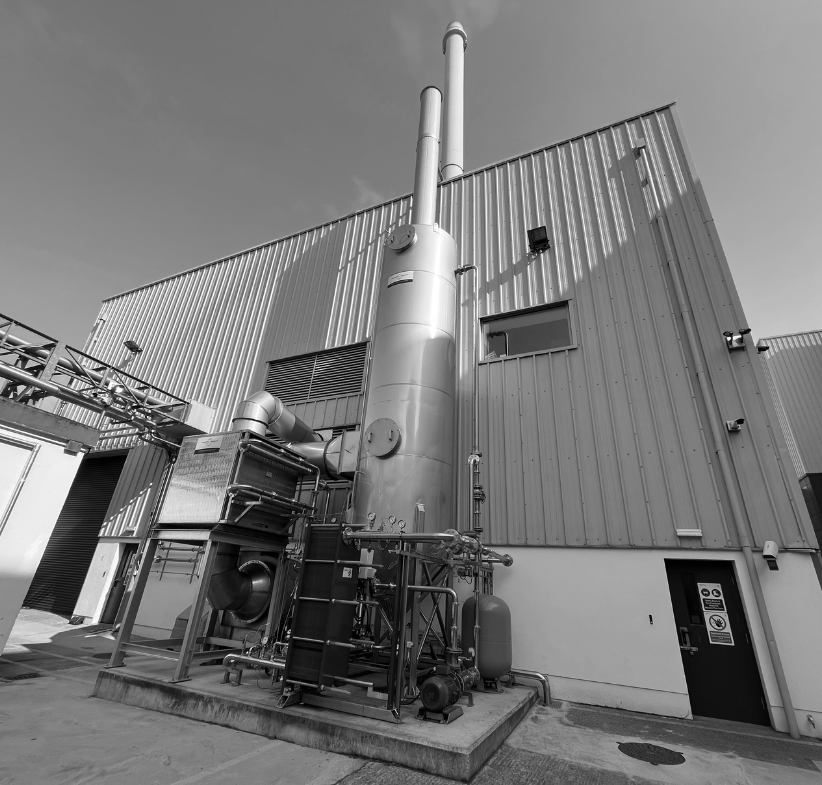
This facility is one of the customer’s largest specialised nutrition manufacturing plants. Operating 24/7, it produces formula milk and plays a critical role in supplying trusted global brands relied upon by parents and healthcare professionals. With a highly complex steam system, success depended not only on the right technology but also the expertise to integrate it seamlessly, ensuring efficiency gains will be delivered without compromising strict hygiene standards, process reliability, or product quality.
Unlocking Biomass Potential
As part of its transition towards net zero, this customer invested in a biomass steam boiler fuelled with sustainable wood chips. To maximise both efficiency and output, the company partnered with Thermal Energy International to install a FLU-ACE direct contact heat recovery system.
The system captures waste heat from the biomass boiler exhaust and redirects it to preheat key air and water streams across the site. By also preheating the combustion air, the biomass boiler now delivers significantly higher steam output while using less fuel, reducing reliance on natural gas during periods of peak demand.
Reliability in High Fouling Environments
Biomass boiler exhaust contains high levels of particulate matter, which makes it a particularly challenging heat source to recover from. To overcome this, Thermal Energy International designed a bespoke direct contact heat exchanger with integrated measures to prevent blockages and manage build up. These include optimised internal geometries, an enhanced heat transfer surface area, and self cleaning systems such as automatic filtration, clean in place, and steam injection.
Together, these measures provide resilience against the variability of woodchip combustion, reduce manual maintenance requirements, and ensure long term reliability.
Distributing Energy Across Critical Processes
The recovered energy from the FLU-ACE system was distributed across seven critical process streams, each with its own operational and integration challenges.
- Boiler Air: Two combustion air streams were preheated, significantly improving boiler efficiency and enabling higher biomass throughput.
- Dryer Air: Several air streams feeding the spray dryer were heated with recovered energy, reducing steam demand in the drying process. Installation was coordinated with scheduled dryer shutdowns to ensure seamless integration without disrupting production.
- Pasteurisation Water: Hot water for pasteurisation was also integrated into the FLU-ACE system, delivered upstream of the steam heat exchangers to reduce their demand. Integration was carefully managed to maintain the strict temperature control required to protect product quality.
- Boiler Make Up Water: Reverse osmosis purified water was preheated before entering the feed tank. To enable this safely, a dedicated pump skid was installed to buffer additional back pressure and protect the membranes against damage.
Proven Performance and Results
The FLU-ACE system is already delivering up to 1 MW of recovered energy, with capacity expected to rise further during colder months. This represents around 20% of the boiler’s fuel input and a significant gain in efficiency.
Based on customer projections, the system is also expected to reduce natural gas use by approximately 7,700 MWh per year and improve effective fuel utilisation by about 20%. Steam output is projected to increase by around 24%, a figure that site operators have already begun to observe in practice:
Previously the absolute maximum amount of steam we could get out of the biomass boiler was 4.5 tonnes per hour. Since the FLU-ACE has been installed we are now regularly at around 5.6 tonnes per hour.
This project builds on the success of a previous pilot installation of Thermal Energy’s FLU-ACE technology at another site in Europe, where energy consumption was reduced by 12%. The same technology was then replicated at this site to recover waste heat from the spray dryer burner exhaust and use it to preheat incoming air, reducing the load on existing heaters.
By enhancing biomass performance, the project has advanced the customer’s progress towards long term carbon reduction targets, ensured secure steam supply for critical nutrition processes, and provided clear, verifiable evidence of sustainability progress that can be communicated to consumers with confidence